1. Introduction
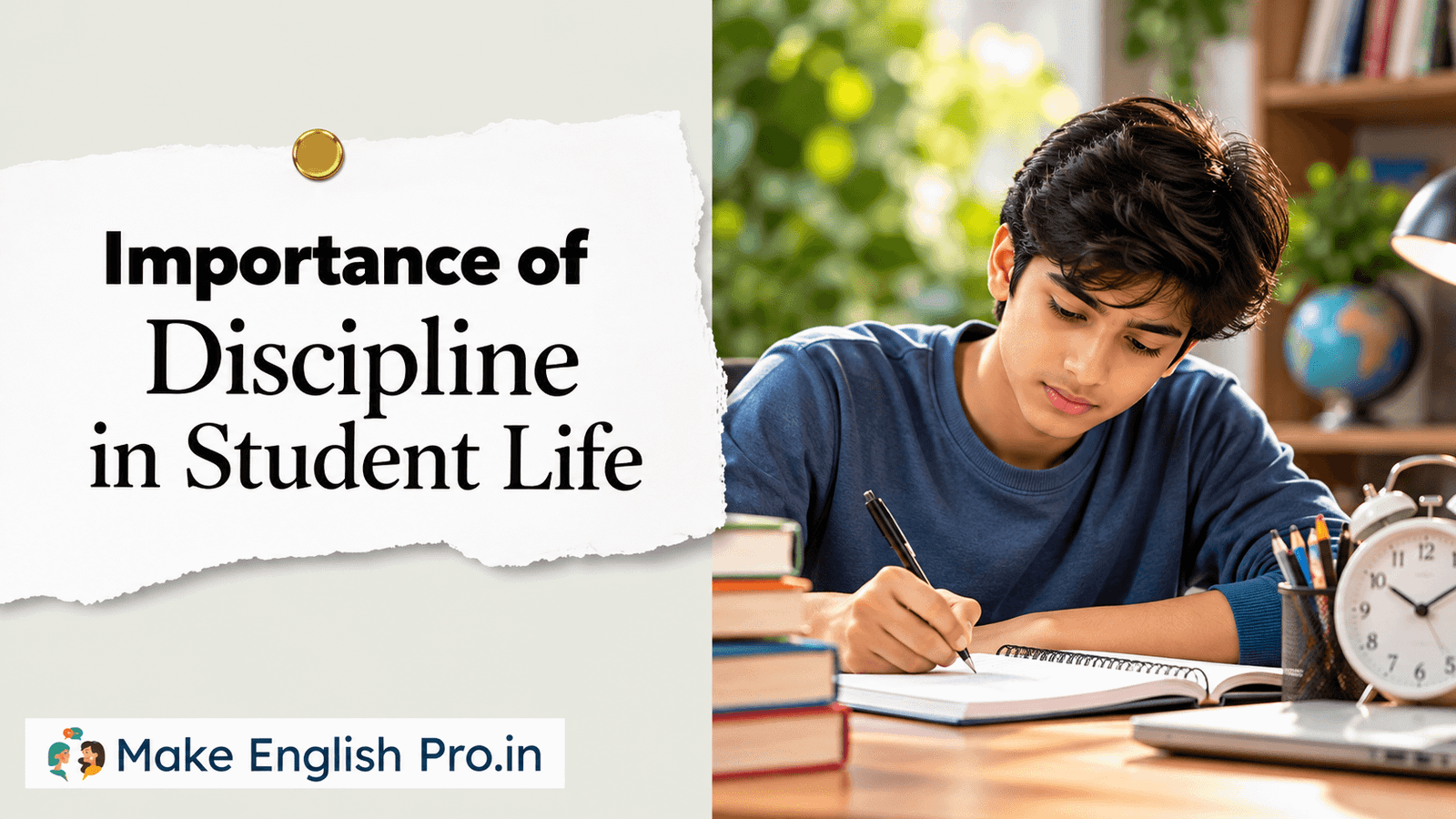
Discipline is one of the most important qualities in a student’s life. It helps students become responsible, hardworking, and successful individuals. A student who follows discipline can manage time properly, complete homework on time, respect teachers, and focus on studies. Discipline also helps students develop good habits that remain useful throughout their lives.
Student life is the foundation of our future. During this period, we learn many things that shape our personality and character. We learn not only from books but also from our teachers, parents, friends, and daily experiences. If we develop discipline at an early age, it becomes easier to face the challenges of life.
Discipline does not mean living under pressure or following every rule without understanding it. It means learning to control our actions, manage our time, and do the right things even when nobody is watching us.
For example, a disciplined student wakes up on time, attends school regularly, listens carefully in class, and completes assignments without waiting until the last moment. These small habits may seem ordinary, but they make a big difference over time.
In simple words, discipline teaches students how to live in an organised and responsible way. It is an important step towards achieving success in education and life.
2. Meaning of Discipline
Discipline means following good habits, respecting rules, controlling our behaviour, and completing our responsibilities on time. It helps us understand the difference between what we want to do and what we should do.
For example, a student may want to play games on a mobile phone for several hours. However, if an examination is approaching, the student should make time for revision before playing. Choosing to study first and play later is an example of self-discipline.
Discipline can be followed at home, in school, on the playground, and in public places. At home, it means respecting family members and helping with small responsibilities. At school, it means attending classes, following reasonable rules, and treating others politely. On the playground, it means playing fairly and respecting the decisions of the referee.
There are two important forms of discipline: external discipline and self-discipline. External discipline comes from rules made by parents, teachers, schools, or other authorities. Self-discipline comes from within us. It means doing what is right because we understand its importance.
Self-discipline is especially valuable because it helps us make good decisions even when nobody is reminding us.
Therefore, discipline is not simply about following orders. It is about developing the ability to manage ourselves and act responsibly.
3. Why Is Discipline Important in Student Life?
Discipline is important in student life because it helps students use their time and abilities wisely. Every student has limited time each day. Without proper planning, much of that time may be wasted on unnecessary activities.
A disciplined student knows when to study, when to play, when to rest, and when to help others. This balance makes student life more organised and less stressful.
Discipline also helps students remain focused on their goals. For example, a student who wants to score good marks in Class 10 examinations must study regularly throughout the year. Studying only one night before an examination may not provide enough time to understand every subject properly.
Similarly, students who practise Mathematics regularly become more familiar with different types of questions. Those who read English daily gradually improve their vocabulary, grammar, and writing skills.
Discipline also improves behaviour. Students learn to respect teachers, cooperate with classmates, follow school rules, and take responsibility for their actions.
Another important benefit is that discipline helps students recover from failure. Instead of giving up after receiving low marks, a disciplined student identifies mistakes, practises difficult topics, and tries again.
In this way, discipline supports academic progress, personal growth, and emotional strength. It helps students build a strong foundation for their future.
4. Discipline and Academic Success
Academic success requires more than intelligence. Regular effort, proper planning, and consistent practice are equally important. Discipline helps students develop these qualities.
A student who studies for a reasonable amount of time every day often understands lessons better than someone who studies only before examinations. Regular revision keeps important information fresh in the mind and helps students identify topics they have not understood.
For example, suppose a student has difficulty solving algebra questions. If the student practises a few questions daily and asks the teacher for help when necessary, the topic may gradually become easier. However, avoiding the topic until the examination may increase confusion and fear.
Discipline also encourages students to complete homework on time. Homework gives them an opportunity to practise what they have learned in class.
Another benefit is that disciplined students are more likely to prepare their books, notebooks, and other study materials in advance. This saves time and reduces unnecessary worry.
However, academic success does not depend on discipline alone. Good teaching, suitable learning resources, health, family support, and individual learning needs also matter. Students should seek help whenever they face difficulties.
Discipline should help students learn better, not force them to study continuously without rest.
Therefore, regular study, timely revision, and a willingness to improve are important parts of disciplined learning.
5. Discipline Helps Us Manage Time
Time is one of the most valuable things in our lives. Once time has passed, we cannot bring it back. Discipline teaches students how to use their time carefully.
Many students complain that they do not have enough time to complete their homework or prepare for examinations. Sometimes the problem is not a lack of time but a lack of planning.
A simple daily timetable can help students organise their activities. They can decide when to attend school, complete homework, revise lessons, play outdoor games, eat meals, and sleep.
For example, a student may spend two hours scrolling through social media without noticing how quickly the time passes. If the student sets a reasonable limit on phone use, that time can be used for studying, exercising, or enjoying a hobby.
Time management does not mean filling every minute with work. Rest and free time are also important. A good timetable should be realistic and flexible enough to accommodate unexpected activities.
Students should also learn to complete important tasks before moving to less important ones. This reduces last-minute pressure.
Developing good time-management habits during school can help students later in college, employment, and family life.
Thus, discipline teaches students to value time and use it in a balanced and productive way.
6. Discipline Builds Good Habits
Our daily habits have a strong influence on our lives. Good habits make useful activities easier, while harmful habits can create difficulties over time.
Discipline helps students develop habits such as waking up at a suitable time, keeping their surroundings clean, reading regularly, completing assignments, and preparing for the next day.
For example, a student who packs a schoolbag at night is less likely to forget books or notebooks in the morning. Similarly, a student who revises lessons every evening may feel more prepared when a teacher asks questions in class.
Good habits do not develop in a single day. They require repeated effort and patience.
At first, students may find it difficult to follow a timetable or reduce unnecessary phone use. However, starting with small changes can make the process easier.
A student can begin by reading for twenty minutes daily, keeping a clean study table, or completing homework before watching television.
It is also important to remember that nobody follows a perfect routine every day. Sometimes we make mistakes or fail to complete a task. Instead of feeling discouraged, we should begin again and try to improve.
Discipline helps turn good intentions into regular actions.
When students develop good habits early in life, those habits can support them for many years.
7. Discipline in School
School is one of the first places where children learn to live and work with people outside their families. Discipline helps maintain a peaceful and productive school environment.
Students should arrive on time, attend classes regularly, listen when others are speaking, and follow reasonable classroom rules. They should complete their work honestly and avoid disturbing other students.
For example, when one student speaks during a lesson, other students should listen rather than shouting over them. This allows everyone to understand the topic properly.
Discipline also includes keeping classrooms clean, protecting school property, and treating teachers and classmates with respect.
On the playground, students should follow the rules of games, play fairly, and accept that they may not win every time. Winning is enjoyable, but learning teamwork and sportsmanship is equally valuable.
School discipline should not be based on fear or humiliation. Students should understand why rules exist, and teachers should enforce them fairly.
If a student makes a mistake, the aim should be to help the student understand the consequences and improve their behaviour.
A disciplined school is not one where students remain silent all the time. It is one where students can ask questions, express ideas respectfully, and learn without unnecessary disturbance.
Therefore, discipline makes schools safer, friendlier, and more effective places for learning.
8. Discipline at Home
Discipline is not limited to school. It is equally important at home, where students learn many of their first habits and values.
Students can practise discipline by waking up on time, keeping their rooms organised, helping with household tasks, respecting family members, and completing their responsibilities.
For example, a student can keep books in their proper place, help arrange the dining table, or prepare school materials for the next day.
These activities may appear small, but they teach responsibility and cooperation.
Discipline at home also means speaking politely and listening to parents or guardians. Family members may sometimes disagree, but disagreements should be handled with respect rather than shouting or insulting one another.
Parents also play an important role. They can help children develop routines, explain the reasons behind household rules, and set a good example through their own behaviour.
However, students also need time for privacy, relaxation, hobbies, and friendships. A balanced home environment should encourage responsibility without placing unreasonable pressure on children.
When students learn to manage their responsibilities at home, they become better prepared to handle duties outside the family.
Thus, discipline at home supports good relationships and helps students become more independent.
9. Discipline and Self-Control
Self-control means managing our emotions, thoughts, and actions instead of reacting immediately to every feeling or desire.
Students sometimes feel angry, disappointed, jealous, or frustrated. These emotions are normal, but the way we respond to them matters.
For example, if a classmate makes an unkind comment, a student may feel like shouting or starting an argument. Self-control helps the student pause, think about the situation, and choose a more sensible response.
Similarly, students may feel tempted to check their phones during study time. Self-discipline helps them put the phone aside until they have finished an important task.
Self-control also helps students avoid cheating during examinations, spreading rumours, or making decisions simply because their friends are doing the same thing.
Developing self-control takes practice. Students can begin by taking a few deep breaths when upset, thinking before speaking, and asking a trusted adult for guidance when a problem feels difficult.
Self-control does not mean hiding every emotion or never asking for help. It means expressing feelings in a safe and respectful way.
By learning to control their reactions, students can make better decisions and build healthier relationships.
Therefore, self-control is an important part of discipline and personal development.
10. Discipline and Physical Health
Good health is necessary for effective learning. Discipline can help students develop healthy routines that support their physical well-being.
Students should try to get sufficient sleep, eat balanced meals, drink enough water, maintain personal hygiene, and participate in regular physical activity.
For example, students who stay awake late every night using mobile phones may feel tired during school hours. A consistent sleep routine can help them feel more rested and attentive.
Similarly, outdoor games, walking, cycling, and other suitable physical activities help students remain active and provide a break from sitting for long periods.
Discipline also encourages students to maintain cleanliness, wash their hands, and follow basic safety practices.
However, a healthy routine should be realistic. Students should not skip meals, avoid necessary rest, or exercise excessively in the name of discipline.
Physical health can also be affected by illness, family circumstances, and other factors that are not completely under a student’s control. Students should seek appropriate support when needed.
The purpose of discipline is to encourage healthy choices, not to make students feel guilty whenever their routine changes.
By developing balanced habits, students can support their health and make daily learning easier.
11. Discipline and Mental Well-Being
Student life can sometimes be stressful. Homework, examinations, family expectations, friendships, and worries about the future may make students feel overwhelmed.
Discipline can help by providing structure and making daily responsibilities easier to manage.
For example, a student who divides a large assignment into smaller tasks may find it less frightening than a student who waits until the deadline is near.
A realistic timetable can also help students balance studying with rest, hobbies, and time with family and friends.
Discipline may encourage helpful habits such as journaling, taking short breaks, spending time outdoors, and asking for help when necessary.
However, discipline should never be confused with working continuously or expecting perfection from ourselves.
Students sometimes become ill, feel tired, or struggle with difficult subjects. On such days, adjusting the schedule and getting support may be the wisest decision.
If a student feels persistently sad, anxious, or unable to cope, talking to a trusted adult, school counsellor, or qualified mental health professional can be helpful.
A disciplined life should support well-being rather than increase unnecessary pressure.
True discipline includes knowing when to work, when to rest, and when to ask for help.
12. Discipline in the Age of Mobile Phones and Social Media
Mobile phones and the internet have become important parts of modern student life. They provide access to educational videos, online classes, digital books, and useful learning applications.
At the same time, excessive or uncontrolled use can distract students from their responsibilities.
Social media notifications, online games, and short videos can make it difficult to concentrate on a lesson for a long time.
Discipline helps students use technology in a balanced way.
For example, a student can keep the phone away while studying, switch off unnecessary notifications, and use educational websites for a specific purpose.
Students should also set reasonable limits on entertainment and avoid using screens so late at night that their sleep is affected.
Digital discipline includes protecting personal information, avoiding suspicious links, checking whether online information is reliable, and behaving respectfully on the internet.
Students should remember that everything shared online may not remain private.
Technology itself is not bad. The important thing is to learn how to use it wisely.
A student who can enjoy digital entertainment without neglecting studies, health, or relationships is practising useful self-discipline.
In the modern world, learning to manage technology is an important life skill.
13. Discipline Teaches Respect and Good Manners
Respect is an important part of a disciplined life. It helps us build positive relationships with teachers, parents, friends, and other people in society.
Students can show respect by speaking politely, listening carefully, waiting for their turn, and treating others fairly.
For example, interrupting someone repeatedly during a conversation may make that person feel ignored. Listening patiently shows that we value what the other person has to say.
Good manners also include saying “please,” “thank you,” and “sorry” when appropriate.
Students should respect school staff, public workers, and people from different backgrounds. They should not bully others because of their appearance, language, financial condition, or academic performance.
Respect does not mean that students must agree with everything adults say. They can ask questions, express disagreement, and report unfair treatment while remaining respectful.
Likewise, discipline does not mean accepting bullying or harmful behaviour in silence. Students should seek help from a trusted adult when they feel unsafe.
A respectful environment allows everyone to feel valued and included.
Thus, discipline helps students understand that good behaviour is not only about following rules but also about treating people with dignity.
14. Discipline and Leadership
Leadership means guiding people towards a common goal, taking responsibility, and helping a group work effectively.
Discipline is an important quality for a good leader because leadership requires reliability, patience, and thoughtful decision-making.
For example, a student who leads a school project must organise tasks, communicate clearly, and make sure that group members have opportunities to contribute.
A disciplined leader arrives prepared, keeps promises, and accepts responsibility when something goes wrong.
Leadership is not simply about giving orders. It also involves listening to others, solving problems, and encouraging people who need support.
Students can develop leadership skills by participating in school activities, sports teams, cultural programmes, and group projects.
They should also learn to accept feedback and recognise the contributions of others.
A student who helps classmates understand a difficult topic can demonstrate leadership even without holding an official position.
Discipline makes leadership more effective because people are more likely to trust someone who behaves responsibly and consistently.
These qualities can be useful later in college, employment, business, and community activities.
Therefore, discipline helps students become dependable individuals who can guide others in a positive way.
15. Discipline in Sports and Other Activities
Sports and extracurricular activities are important parts of student life. They help students develop physical fitness, creativity, teamwork, confidence, and new interests.
Discipline is necessary for making the most of these activities.
In sports, students need to practise regularly, follow the rules, respect teammates, and listen to their coach.
For example, a player who attends practice consistently may improve their skills more effectively than someone who practises only before a competition.
Sports also teach students to accept victory and defeat with maturity. Losing a match can be disappointing, but it can also show a player which skills need improvement.
Discipline is equally important in music, dance, drawing, debate, and other creative activities. Regular practice helps students develop their abilities over time.
Students should not focus only on winning prizes. Participation, learning, and enjoyment also have value.
Balancing studies with extracurricular activities requires planning, but students should not be expected to perform perfectly in every area.
When students manage their time and practise consistently, they can enjoy their interests while meeting their academic responsibilities.
Thus, discipline supports growth both inside and outside the classroom.
16. Discipline Helps Us Achieve Our Goals
Every student has dreams and goals. Some want to become doctors, engineers, teachers, scientists, police officers, artists, or entrepreneurs. Others may still be exploring what they want to do in the future.
Whatever the goal, discipline helps turn plans into action.
For example, a student who wants to improve English speaking skills can practise a few sentences daily, read simple stories, and speak with friends or teachers.
A student who wants to improve Mathematics can solve questions regularly and review mistakes.
Large goals often seem difficult when we look at the entire task at once. Discipline teaches us to divide them into smaller, manageable steps.
It also helps us continue working when motivation is low.
Motivation can change from day to day. Sometimes we feel energetic, while on other days we feel tired or distracted. A simple routine can help us continue making progress without depending entirely on our mood.
However, goals should be realistic and flexible. Students may need to change their plans as they discover new interests or face unexpected circumstances.
Success is not always immediate, and progress may sometimes be slow.
Discipline encourages patience, regular effort, and learning from mistakes.
Therefore, discipline is a useful tool for achieving goals and building a meaningful future.
17. Problems Caused by a Lack of Discipline
A lack of discipline can create difficulties in student life.
Students who regularly postpone their work may struggle to complete assignments before deadlines. Those who do not revise lessons may find it harder to remember important concepts during examinations.
Irregular sleep and excessive screen time can also make it difficult to concentrate during classes.
Lack of discipline may affect relationships as well. Students who repeatedly interrupt others, ignore responsibilities, or refuse to cooperate may find it harder to work in groups.
For example, if one member of a group project fails to complete their assigned work, the other members may have to spend extra time finishing it.
Poor planning can also create unnecessary stress. When several tasks are left unfinished, students may feel confused about where to begin.
However, students should not label themselves as failures because they sometimes struggle with discipline. Everyone develops habits gradually, and many difficulties have understandable causes.
A student may need help with time management, study methods, health, family responsibilities, or attention.
The important thing is to recognise the problem and take practical steps towards improvement.
Small changes, regular practice, and suitable support can help students develop better habits.
Thus, discipline is not about never making mistakes; it is about learning from them and trying to do better.
18. How Can Students Develop Discipline?
Discipline can be developed through small, consistent actions. Students do not need to change their entire routine in one day.
The following steps can help:
1. Make a realistic timetable. Set suitable times for studying, schoolwork, meals, exercise, relaxation, and sleep.
2. Set clear goals. Decide what you want to complete today rather than making only vague plans.
3. Start with small tasks. Begin with a short study session or one assignment. Gradually increase your effort as the habit becomes easier.
4. Complete important work first. Try to finish urgent or difficult tasks before spending too much time on entertainment.
5. Reduce distractions. Keep unnecessary notifications off and place your phone away when you need to concentrate.
6. Revise regularly. Review lessons throughout the week instead of depending entirely on last-minute preparation.
7. Take care of your health. Eat balanced meals, stay active, and get enough sleep.
8. Accept mistakes. If you fail to follow your routine one day, identify the reason and start again.
9. Ask for help. Teachers, parents, and trusted adults can help you solve problems and improve your habits.
10. Be patient with yourself. Developing discipline takes time. Regular effort is more useful than trying to follow an impossible routine for a few days.
Students should remember that a good timetable is a guide, not a punishment. It should help them manage their lives rather than make them feel constantly pressured.
By following these steps, students can gradually become more organised, confident, and responsible.
19. Role of Parents and Teachers in Developing Discipline
Parents and teachers play an important role in helping students develop discipline.
Parents can support children by maintaining reasonable routines at home, encouraging regular study, and teaching them to take responsibility for their actions.
They should explain rules clearly and apply them fairly. Children are more likely to understand discipline when they know why a particular rule exists.
Parents should also set a good example. If adults expect children to manage time carefully, they should try to demonstrate responsible time management themselves.
Teachers can develop discipline by making lessons interesting, setting clear expectations, and treating students fairly.
They can encourage punctuality, honesty, cooperation, and independent thinking through classroom activities.
For example, group projects can teach students to share responsibilities, while classroom discussions can help them practise listening and speaking respectfully.
When students make mistakes, parents and teachers should try to understand the reason behind the behaviour and guide them towards improvement.
Harsh punishment, humiliation, and constant criticism may damage confidence rather than teach responsible behaviour.
Students also need opportunities to make choices and learn from the consequences of their decisions.
Discipline becomes more effective when adults combine clear boundaries with patience, encouragement, and respect.
Therefore, parents and teachers should work together to help students become self-disciplined rather than simply obedient.
20. Discipline and Success in Future Life
The habits students develop during school can influence their future lives.
In college, students need to attend classes, complete projects, prepare for examinations, and manage greater independence. Discipline can help them handle these responsibilities.
In professional life, employees often need to arrive on time, meet deadlines, communicate clearly, and work cooperatively with colleagues.
Entrepreneurs also need discipline to manage money, serve customers, plan their work, and continue improving their businesses.
Discipline is equally useful in personal life. It can help people maintain healthy routines, manage household responsibilities, save money, and keep their promises.
For example, a person who develops a habit of saving a small amount regularly may gradually build financial security, depending on their income and circumstances.
However, discipline does not guarantee that every person will become wealthy or achieve every goal. Opportunities, education, health, resources, and unexpected events also influence success.
The value of discipline lies in helping people make better use of the opportunities available to them.
It helps us remain organised, respond thoughtfully to problems, and continue learning throughout life.
Therefore, the lessons of discipline learned during student life can remain useful long after school is over.
21. Discipline Is Not the Same as Strictness
Some people believe that a disciplined student must always remain silent, follow every instruction without question, and study for many hours every day. This is not a complete understanding of discipline.
True discipline means behaving responsibly, respecting others, and making sensible decisions.
A disciplined student can ask questions, disagree respectfully, participate in discussions, and express personal opinions.
For example, if a student does not understand a lesson, asking the teacher to explain it again is a responsible action. Remaining silent out of fear may prevent learning.
Similarly, taking a break after studying is not a sign of laziness. Rest helps students maintain concentration and avoid unnecessary exhaustion.
Discipline should also allow students to enjoy hobbies, spend time with friends, and explore their interests.
Rules are useful when they protect safety, support learning, and encourage fairness. However, rules should be reasonable and applied without discrimination.
Students should learn to understand the purpose of rules instead of following them only because they are afraid of punishment.
Self-discipline develops when people understand their responsibilities and learn to manage their own behaviour.
Therefore, discipline should create balance, freedom with responsibility, and healthy personal growth rather than fear and excessive control.
22. My Views on Discipline in Student Life
In my opinion, discipline is one of the most valuable qualities a student can develop.
I believe students should understand that success does not usually come from one day of hard work. It often comes from regular effort, patience, and a willingness to improve.
A student does not need to be perfect to become disciplined. Even small actions, such as completing homework on time, reading for a few minutes daily, or preparing a schoolbag at night, can make a difference.
I also believe that students should balance their studies with physical activities, hobbies, rest, and family time.
They should respect their teachers and parents while learning to think independently and ask questions.
When students make mistakes, they should accept responsibility and try to improve rather than hide their problems.
At the same time, adults should remember that every student has different needs and circumstances. Guidance and encouragement are often more helpful than unnecessary pressure.
My aim as a student should not be only to obtain good marks but also to develop good character, useful skills, and a responsible attitude.
Discipline can help me work towards these goals and become a better person.
23. Conclusion
Discipline is an essential part of student life. It teaches students to manage their time, develop good habits, respect others, and take responsibility for their actions.
It helps improve learning by encouraging regular study, revision, and consistent practice. It also supports physical health, mental well-being, teamwork, leadership, and personal development.
Discipline prepares students for the responsibilities they will face in college, employment, family life, and society.
However, discipline does not mean living under constant pressure or following rules without understanding them. True discipline involves self-control, balance, respect, and the ability to make sensible decisions.
Students should develop discipline gradually by setting realistic goals, reducing distractions, following healthy routines, and learning from mistakes.
Parents and teachers should guide them with patience and provide a supportive environment in which they can grow.
Every student has the potential to improve. What matters is the willingness to make small, positive changes and continue practising them.
In conclusion, discipline is not merely a rule to follow; it is a life skill that helps us use our time wisely, develop our abilities, and move towards our goals.
A disciplined student builds good habits today and creates better opportunities for tomorrow.