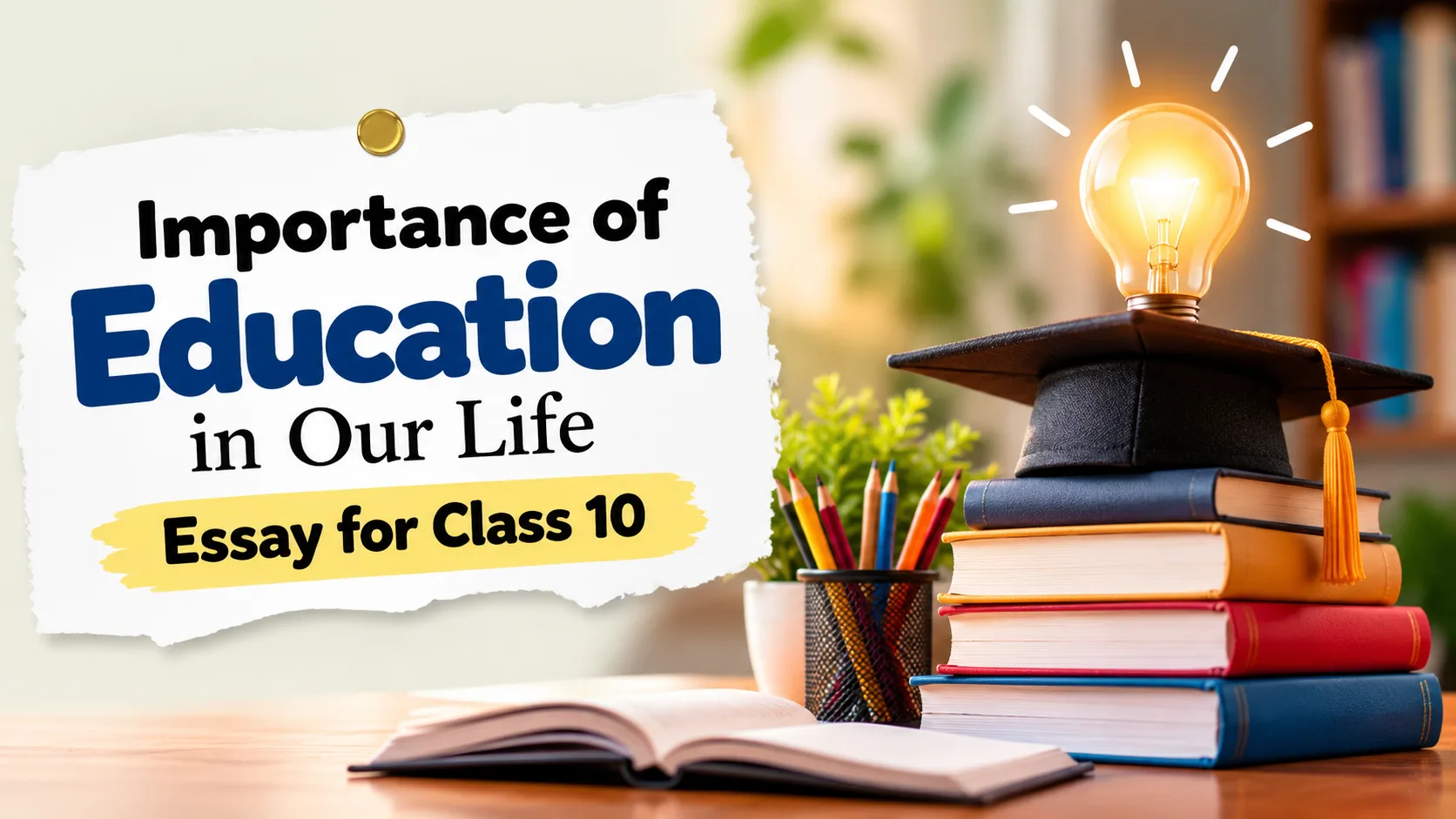
Essay for Class 10 Students
1. Introduction
Education is one of the most important things in our life. It plays a very important role in making us successful, responsible, and knowledgeable people. Education helps us understand the world around us and teaches us how to live a better life. It gives us knowledge, develops our thinking ability, and helps us distinguish between right and wrong.
Education is not limited to reading books or passing examinations. It is a continuous process of learning new things, developing good habits, and gaining experience. We learn from our teachers, parents, friends, books, and daily activities. All these things help us become better human beings.
A person without education may find it difficult to understand many things about the world. Education gives us the confidence to face challenges and solve problems. It also helps us achieve our dreams and build a bright future.
In today’s modern world, education is necessary for everyone, regardless of gender, religion, caste, or financial background. Every child deserves the opportunity to receive a good education. Education is the foundation of personal growth and national development.
Therefore, we can say that education is not just a means of earning money; it is also a way to improve our lives and make society better.
2. Meaning of Education
Education means gaining knowledge, learning skills, and developing good values. It helps us understand different subjects, such as English, Hindi, Mathematics, Science, Social Science, and Computer Science.
The word education has a much broader meaning than studying in a school or college. It teaches us how to communicate with others, respect people, make decisions, and behave properly in society.
For example, when a child learns to read a book, it is education. When a student learns to respect elders, it is also education. Similarly, when a person learns to solve a problem peacefully instead of fighting, that person is applying the lessons of education.
Education develops our mind as well as our character. It helps us become independent and responsible citizens.
There are different ways of receiving education. Some people learn in schools and colleges, while others learn through online classes, vocational training, practical work, and personal experiences.
In simple words, education is the process of learning knowledge, skills, and values that help us live a meaningful and successful life.
3. Education Builds Our Knowledge
The first and most important benefit of education is that it increases our knowledge. It helps us understand the world and discover new things.
Through education, we learn about history, geography, science, mathematics, literature, and many other subjects. These subjects help us understand how our world works.
For example, Science teaches us about plants, animals, the human body, and the universe. Geography helps us understand different countries, rivers, mountains, and climates. History tells us about the lives and achievements of people who lived in the past.
Education also helps us understand current events and important social issues. An educated person can read newspapers, understand public information, and make informed decisions.
Knowledge makes us more confident because we can understand situations instead of depending on guesses or rumours.
However, education should not be limited to memorising facts. Students should try to understand what they learn and use that knowledge in real life.
Thus, education opens the door to knowledge and helps us become aware of the world around us.
4. Education Develops Our Personality
Education plays a major role in developing our personality. It helps us become confident, disciplined, polite, and responsible.
A student’s personality develops through classroom activities, group discussions, sports, competitions, and interactions with teachers and classmates.
When students participate in debates, speeches, and presentations, they learn to express their ideas clearly. These activities reduce hesitation and improve communication skills.
Education also teaches us the importance of punctuality, honesty, patience, and hard work. Students learn to complete their assignments on time and follow rules.
A well-educated person should not only have knowledge but also possess good manners and a positive attitude.
For example, a student who respects classmates, helps weaker students, and speaks politely demonstrates good character.
Education helps us recognise our strengths and weaknesses. It encourages us to improve ourselves and develop a positive outlook towards life.
Therefore, education is essential for the all-round development of our personality.
5. Education Helps Us Distinguish Between Right and Wrong
Education helps us develop the ability to think carefully and make wise decisions. It teaches us about honesty, justice, equality, kindness, and responsibility.
In our daily lives, we often face situations in which we must choose between right and wrong. Education helps us understand the possible consequences of our actions.
For example, a student may be tempted to cheat during an examination. However, the values learned through education teach the student that honesty is more important than obtaining marks through unfair means.
Similarly, education helps us understand why we should not bully others, spread rumours, or discriminate against people.
An educated person should question harmful practices and think logically before accepting information.
Education also teaches us to respect different opinions. We may disagree with someone without insulting or hurting that person.
Moral education is especially important because knowledge without good values may be misused.
Thus, education helps us develop a strong moral character and become responsible members of society.
6. Education Is Important for a Successful Career
Education plays an important role in building a successful career. It provides the knowledge and skills required for different professions.
Doctors need education to treat patients. Engineers need technical knowledge to design and build structures. Teachers need education to guide students. Lawyers study the law, while scientists learn how to conduct research and make discoveries.
Similarly, accountants, computer programmers, nurses, architects, and many other professionals need appropriate education and training.
Education also improves our employment opportunities. Many organisations require candidates to have specific qualifications and skills.
However, a degree alone does not guarantee success. Practical knowledge, communication skills, discipline, creativity, and experience are also important.
Students should therefore focus on understanding concepts and developing useful skills instead of studying only to obtain marks.
Education also helps people start their own businesses. An educated entrepreneur may understand budgeting, marketing, customer service, and business planning more effectively.
In this way, education prepares students for future responsibilities and helps them work towards financial independence.
7. Education Makes Us Independent
Education helps us become independent in our personal and professional lives. It gives us the knowledge and confidence to make our own decisions.
An educated person can read documents, understand instructions, use digital services, and manage many everyday tasks without always depending on others.
For example, basic financial education helps us understand bank accounts, savings, interest, and responsible spending. Digital education helps us use computers, smartphones, and online services safely.
Education also develops problem-solving skills. Instead of giving up when a difficulty arises, an educated person can examine the situation and search for possible solutions.
Financial independence is another important benefit of education. By gaining useful qualifications and skills, people may find better employment opportunities and support themselves and their families.
However, independence does not mean refusing help from others. It means having the ability to think, act responsibly, and manage our lives while cooperating with other people.
Therefore, education is an important step towards becoming self-reliant and confident.
8. Education Removes Poverty
Education can help reduce poverty by improving people’s access to employment, skills, and economic opportunities.
Poor families often face difficulties in providing food, healthcare, and education to their children. When children receive a good education, they may gain better opportunities to earn a living in the future.
For example, a student from a financially weak family may become a teacher, nurse, engineer, skilled technician, or entrepreneur after receiving suitable education and training.
Such opportunities can improve the living conditions of the student and the family.
Education also helps people understand government schemes, financial services, employment opportunities, and their legal rights.
Vocational education is particularly useful for students who want to learn practical skills, such as electrical work, computer operations, tailoring, plumbing, or other trades.
However, education alone cannot remove poverty completely. Employment opportunities, affordable healthcare, fair wages, and economic development are also necessary.
Nevertheless, education is one of the strongest tools for reducing poverty and creating opportunities for a better future.
9. Education Promotes Equality
Education promotes equality by giving people the opportunity to improve their lives regardless of their background.
Every child should have access to quality education, whether the child belongs to a rich or poor family, lives in a village or a city, or comes from a different social background.
Education helps us understand that every human being deserves dignity and respect.
It challenges harmful beliefs about caste, gender, religion, disability, and economic status.
For example, a girl who receives a good education can develop professional skills, become financially independent, and participate confidently in society.
Similarly, children from disadvantaged communities can use education to improve their opportunities and contribute to national development.
Schools also bring together students from different backgrounds. They learn to cooperate, share ideas, and respect one another.
Equal access to education does not mean that every student will achieve the same results. Students have different interests, abilities, and circumstances. It means that everyone should receive a fair opportunity to learn and grow.
Thus, education can help build a more equal, respectful, and inclusive society.
10. Education Empowers Women
Women’s education is essential for the progress of families, communities, and the entire nation.
When girls receive education, they gain knowledge, confidence, and the ability to make informed decisions about their lives.
Educated women can pursue careers, manage finances, understand their rights, and participate in social and public activities.
They can also make informed decisions about health, nutrition, family welfare, and their children’s education.
For example, an educated mother can encourage her children to attend school regularly and develop good study habits.
However, the importance of women’s education goes far beyond their roles within a family. Women can become scientists, doctors, engineers, teachers, entrepreneurs, officers, and leaders.
Girls should receive the same encouragement and opportunities as boys. Families and communities must avoid practices that prevent girls from completing their education.
A society cannot achieve its full potential if half of its population is denied equal opportunities.
Therefore, educating girls and women is not only a matter of fairness but also an essential condition for social and economic development.
11. Education Helps in the Development of Our Nation
Education is one of the foundations of national development. An educated population can contribute to the progress of science, technology, agriculture, industry, healthcare, and public administration.
Doctors improve healthcare services. Engineers develop roads, bridges, and other infrastructure. Teachers educate future generations. Scientists conduct research, and skilled workers help industries operate efficiently.
Education also helps citizens understand their duties and responsibilities.
In a democratic country like India, educated citizens may be better prepared to understand public issues, evaluate information, and participate thoughtfully in elections and community activities.
Education can encourage innovation and entrepreneurship. When people develop new ideas and useful technologies, they can create jobs and solve social problems.
India has made progress in many fields, including information technology, medicine, space research, and engineering. Education and skill development play an important role in supporting such progress.
However, national development requires more than academic qualifications. Ethical leadership, equal opportunities, practical skills, scientific thinking, and good public institutions are also necessary.
Thus, investing in education is an investment in the future of our country.
12. Education and Technology
Technology has changed the way people learn and share information. Today, students can access educational resources through computers, smartphones, and the internet.
Online classes, educational videos, digital libraries, and learning applications allow students to study many subjects from home.
For example, a student living in a village can watch a mathematics lesson online or practise English through educational videos.
Technology can also help teachers explain difficult concepts through animations, diagrams, presentations, and interactive activities.
Artificial intelligence and digital learning tools can support personalised learning when used carefully.
However, technology also has some disadvantages. Students may become distracted by games, social media, and unnecessary internet use. Online information may also be incorrect or misleading.
Therefore, students must learn digital literacy. They should verify information, protect their personal details, avoid suspicious links, and use technology responsibly.
Technology should support classroom learning rather than completely replace teachers and meaningful human interaction.
When used wisely, technology can make education more accessible, interesting, and effective.
13. Education Improves Communication Skills
Communication is an essential part of our daily lives. We communicate with family members, teachers, friends, colleagues, and people in our communities.
Education helps us express our thoughts clearly and understand what others are saying.
Reading improves vocabulary and comprehension. Writing helps us organise ideas. Speaking activities improve confidence, while listening helps us understand different viewpoints.
English is useful in many educational and professional settings. Learning English can help students access books, online resources, and employment opportunities. At the same time, Hindi and regional languages are equally important for cultural understanding and communication.
Students should not feel ashamed of making mistakes while learning a language. Mistakes are a natural part of learning.
For example, a student who regularly reads simple English stories, learns new words, and practises speaking may gradually become more confident.
Good communication is not just about speaking fluently. It also involves listening patiently, using respectful language, and explaining ideas honestly.
Therefore, education helps us communicate effectively and build better relationships with others.
14. Education and Good Health
Education plays an important role in maintaining good health. It helps people understand hygiene, nutrition, exercise, sanitation, and disease prevention.
Students learn why they should wash their hands, drink safe water, eat balanced meals, and maintain personal cleanliness.
Health education also helps people understand the importance of physical activity, sufficient sleep, and mental well-being.
For example, a student who understands the value of a balanced diet may be more likely to choose nutritious food instead of regularly consuming unhealthy snacks.
Education can also help people recognise misleading health claims and understand when professional medical advice is necessary.
Schools can teach students about road safety, first aid, personal safety, and the dangers of tobacco and other harmful substances.
Mental health education is equally important. Students should learn that stress, sadness, and anxiety deserve attention and that asking for help is a sensible step.
However, education does not guarantee good health because healthcare access, living conditions, income, and other factors also matter.
Even so, health education helps people make informed choices and develop healthier habits.
15. Education Protects Us from Superstitions
Education encourages scientific thinking and helps us examine beliefs using evidence and reason.
Superstitions may cause people to fear ordinary events or follow harmful practices without understanding their consequences.
For example, a person may believe that a disease is caused by a supernatural force and avoid seeking proper medical treatment. Scientific education helps people understand that diseases often have biological causes and may require medical care.
Education teaches us to ask questions, investigate evidence, and distinguish between facts and unsupported claims.
It also helps us recognise misinformation spread through rumours, social media, and misleading advertisements.
However, education does not mean disrespecting every cultural or religious tradition. People can respect cultural practices while carefully examining claims that affect health, safety, or the rights of others.
Scientific thinking encourages curiosity rather than blind acceptance.
An educated person should be willing to change an opinion when reliable evidence shows that the opinion is incorrect.
Therefore, education helps society become more rational, informed, and prepared to solve problems.
16. Education Teaches Discipline and Responsibility
Discipline is an important quality for achieving success in life. Education helps students develop discipline by encouraging them to follow routines, respect rules, and complete their responsibilities.
Students learn to arrive at school on time, finish assignments, prepare for examinations, and cooperate with teachers and classmates.
These habits can be useful throughout life.
For example, a student who prepares a daily study timetable may learn how to manage time effectively. Later, the same skill can help the student balance work, family responsibilities, and personal goals.
Education also teaches responsibility towards society and the environment.
We should keep public places clean, follow traffic rules, respect public property, and avoid wasting water and electricity.
A responsible citizen understands that personal actions can affect other people.
Discipline should not be confused with fear or blind obedience. Good discipline involves self-control, respect, and the ability to make sensible choices.
Thus, education helps us become disciplined individuals who understand their duties and work towards their goals.
17. Education and Moral Values
Moral values guide our behaviour and help us build healthy relationships with others.
Education should teach values such as honesty, kindness, cooperation, respect, fairness, patience, and compassion.
These qualities are necessary in families, schools, workplaces, and communities.
For example, an honest student does not copy answers during an examination. A kind student helps a classmate who is struggling with a lesson. A responsible student admits a mistake and tries to correct it.
Education also teaches us to respect people who have different opinions, languages, cultures, and backgrounds.
Moral values help prevent bullying, discrimination, cheating, and unnecessary conflicts.
However, moral education should be demonstrated through actions, not just taught as theory. Teachers, parents, and other adults should set good examples for children.
Academic success is valuable, but character is equally important. A person who has many qualifications but behaves dishonestly cannot be considered truly educated in the broader sense.
Therefore, education should develop both intelligence and character.
18. Education and Environmental Protection
Environmental protection has become an important responsibility in the modern world.
Education helps us understand problems such as air pollution, water pollution, deforestation, climate change, and the loss of biodiversity.
Students learn that human activities can damage the natural environment and affect the health of people, animals, and plants.
For example, throwing plastic waste into rivers can harm aquatic life and pollute water. Cutting down forests can destroy animal habitats and contribute to environmental problems.
Environmental education encourages students to take practical steps to protect nature.
We can plant trees, save water, switch off unnecessary lights, reduce plastic use, and separate waste for proper disposal.
Schools can organise cleanliness drives, tree-planting programmes, and awareness campaigns.
Education also helps future scientists, engineers, farmers, and policymakers develop better environmental solutions.
Protecting the environment requires cooperation among individuals, communities, businesses, and governments.
Thus, education develops environmental awareness and encourages us to become responsible caretakers of the Earth.
19. Education in Rural Areas
Education is especially important in rural areas, where some communities face challenges such as limited educational facilities, long travel distances, financial difficulties, and shortages of trained teachers.
Good schools can create opportunities for children living in villages and small towns.
Education helps rural students learn about modern farming methods, healthcare, technology, business, and employment.
For example, a farmer who receives appropriate training may learn about soil health, water conservation, crop management, and government agricultural services.
Students can also acquire skills that help them pursue careers in teaching, healthcare, engineering, administration, and other fields.
However, rural children should not have to leave their communities merely to access basic quality education. Schools need suitable classrooms, safe drinking water, toilets, learning materials, trained teachers, and reliable access to educational resources.
Digital learning can support rural education, but it cannot solve every problem. Electricity, internet connectivity, devices, and teacher guidance are also necessary.
Equal educational opportunities can help rural communities become stronger and more prosperous.
Therefore, improving education in villages is essential for balanced national development.
20. The Role of Teachers in Education
Teachers play a very important role in the educational development of students.
They explain difficult concepts, answer questions, encourage curiosity, and guide students towards their goals.
A good teacher does not simply ask students to memorise information. Instead, the teacher helps them understand ideas and apply them in practical situations.
Teachers also help students develop confidence, discipline, teamwork, and problem-solving abilities.
For example, when a student struggles with Mathematics, a patient teacher can explain the topic in different ways until the student understands it.
Teachers can recognise students’ strengths and encourage them to improve their weaknesses.
They also help students prepare for examinations and make informed decisions about further education and careers.
However, education is a shared responsibility. Students must attend classes, practise regularly, ask questions, and complete their work. Parents and schools also have important roles.
Teachers deserve respect because their work contributes to the growth of individuals and society.
Thus, teachers are guides who help students build knowledge, character, and confidence.
21. The Role of Parents in Education
Parents are a child’s first teachers. Children begin learning language, manners, habits, and values at home long before they enter school.
Parents can support education by creating a positive learning environment and encouraging children to study regularly.
They should help children understand the importance of education without creating unnecessary pressure.
For example, parents can ask children what they learned at school, listen to their difficulties, and help them organise their study time.
They should provide encouragement rather than comparing one child constantly with another.
Every student has different abilities and interests. Some may perform well in Mathematics, while others may excel in languages, sports, arts, or practical activities.
Parents should recognise these differences and guide children according to their strengths.
They should also maintain communication with teachers and pay attention to a child’s emotional and physical well-being.
Education becomes more effective when parents and teachers work together.
Therefore, the support of parents is essential for a child’s educational success.
22. Education and Students’ Future
Education helps students prepare for their future. Class 10 is an important stage because students begin making decisions about their further studies and career interests.
After Class 10, students may choose Science, Commerce, Humanities, or vocational courses, depending on their interests, abilities, and educational goals.
Students should learn about different options before making a decision.
For example, a student interested in technology may explore computer science or technical training. A student interested in business may consider Commerce, while someone interested in society, history, or public administration may explore Humanities.
These are examples, not strict rules. Many careers allow students from different academic backgrounds to enter through appropriate qualifications and training.
Education also prepares students for changes in the job market. New technologies may create new professions, while existing jobs may require additional skills.
Therefore, students should develop the habit of lifelong learning.
They should focus on understanding concepts, improving communication, gaining practical experience, and discovering their interests.
Education cannot predict every future challenge, but it helps students become more prepared to face them.
23. Problems in the Education System
Although education is very important, many challenges still exist.
Some children cannot attend school regularly because of poverty, family responsibilities, illness, disability, or long distances between home and school.
In some places, schools may lack adequate classrooms, laboratories, libraries, toilets, or trained teachers.
Another problem is that students sometimes focus only on marks instead of understanding concepts. Excessive examination pressure can also affect confidence and well-being.
Some students leave school before completing their education because their families cannot afford related expenses or because they need to work.
Digital inequality is another challenge. Not every student has a smartphone, computer, or reliable internet connection.
These problems require cooperation among governments, schools, parents, communities, and educational organisations.
Schools should provide supportive learning environments, qualified teachers, suitable facilities, and opportunities for practical learning.
Students should also receive guidance about mental well-being, career choices, and the responsible use of technology.
Improving education requires continuous effort and fair opportunities for every child.
24. How Can We Improve Education?
We can improve education by making learning more accessible, practical, inclusive, and student-friendly.
First, every child should have the opportunity to attend a good school, regardless of financial background or gender.
Second, schools should have trained teachers, clean classrooms, libraries, laboratories, and safe drinking water.
Third, teachers should use examples, activities, experiments, discussions, and projects to make lessons easier to understand.
Fourth, students should be encouraged to ask questions instead of memorising everything without understanding it.
Fifth, educational institutions should provide career guidance and practical skill training.
Sixth, technology should be used wisely to support learning. Educational videos, digital books, and online classes can help students practise at their own pace.
Seventh, parents should encourage children and cooperate with teachers.
Finally, students should develop good study habits. They should revise lessons regularly, read books, practise writing, ask for help when needed, and maintain a healthy routine.
Education improves when everyone works together to create a supportive environment.
The goal should not be merely to produce students who pass examinations, but to develop knowledgeable, capable, honest, and responsible citizens.
25. Importance of Education in India
Education is essential for India’s social, economic, and cultural development.
India is a large and diverse country with many languages, religions, traditions, and communities. Education can help people understand this diversity and live together peacefully.
It also provides opportunities for young people to develop skills and contribute to different sectors of the economy.
India needs educated teachers, healthcare workers, scientists, engineers, farmers, entrepreneurs, skilled technicians, and responsible public servants.
Education can help citizens understand their rights and duties. It can also encourage people to participate in community development and democratic processes.
The Right of Children to Free and Compulsory Education Act, 2009, provides a legal framework for free and compulsory elementary education for children aged 6 to 14 years.
The National Education Policy 2020 also emphasises broad educational development, foundational literacy and numeracy, flexibility, and skill development.
However, important challenges remain, including unequal access to educational resources and differences in learning outcomes.
India can progress further by improving school quality, supporting teachers, strengthening vocational education, and making learning opportunities more inclusive.
Education is essential for building a skilled, confident, and responsible India.
26. Education Is More Than Getting Good Marks
Many students believe that education means obtaining high marks in examinations. Although marks are important for many academic opportunities, they do not measure every aspect of a person’s knowledge or ability.
True education involves understanding concepts, asking questions, solving problems, developing skills, and behaving responsibly.
For example, a student may obtain excellent marks in Science but still need practical experience to conduct an experiment confidently.
Similarly, a student with average marks may possess excellent communication skills, creativity, leadership qualities, or technical abilities.
Students should therefore try to understand what they study instead of depending entirely on memorisation.
They should participate in sports, discussions, creative activities, and practical projects whenever possible.
Failure should also be treated as an opportunity to learn. A poor result in one examination does not determine a person’s entire future.
Students should identify their mistakes, seek guidance, and prepare better next time.
Education is a lifelong process, and every experience can teach us something valuable.
Therefore, marks are one part of education, but knowledge, skills, values, and personal growth are equally important.
27. Education and Lifelong Learning
Education does not end when a person finishes school or college. Learning continues throughout life.
The world changes constantly. New technologies, discoveries, professions, and social challenges require people to keep learning.
For example, a computer professional may need to learn new software. A teacher may adopt new teaching methods, while a farmer may learn about improved agricultural techniques.
Reading books, attending training programmes, learning new languages, and gaining practical experience are all ways to continue learning.
Lifelong learning helps people adapt to change and discover new opportunities.
It also keeps the mind active and encourages curiosity.
Students should develop the habit of reading beyond their textbooks. They can read newspapers, biographies, science articles, stories, and books about subjects that interest them.
They should also learn from mistakes and listen to people with different experiences.
A person who remains willing to learn can continue improving at any age.
Thus, education is not a destination but a journey that continues throughout our lives.
28. My Views on the Importance of Education
In my opinion, education is one of the most valuable gifts a person can receive.
It helps us understand ourselves, respect others, and make better decisions. It gives us the ability to work towards our goals and contribute to our families and communities.
I believe every student should take education seriously, but should not become afraid of examinations or marks.
Students should study with curiosity and understand the practical importance of what they learn.
They should respect their teachers, listen to their parents, help their classmates, and use their time wisely.
I also believe that no child should be denied education because of poverty, gender, disability, or social background.
Educated people should help others by sharing knowledge, encouraging children to attend school, and supporting learning opportunities in their communities.
Education should make us humble rather than arrogant. The more we learn, the more we should understand how much there is still to discover.
My aim is to use education not only for personal success but also to become a responsible citizen and a helpful human being.
29. Conclusion
Education is the foundation of a better life and a progressive society. It gives us knowledge, develops our personality, improves our communication skills, and prepares us for future challenges.
It helps reduce poverty, promotes equality, supports women’s empowerment, and contributes to the development of our nation.
Education also teaches us discipline, moral values, scientific thinking, and environmental responsibility.
However, true education is not limited to books, degrees, or examination results. It includes practical skills, good character, creativity, and the ability to make responsible decisions.
Every child should have the opportunity to receive quality education. Governments, teachers, parents, and communities must work together to make this possible.
Students should value their education and use their knowledge wisely. They should continue learning, respect others, and contribute positively to society.
A country becomes stronger when its people are educated, skilled, thoughtful, and responsible.
In conclusion, education is not merely a way to earn money; it is a powerful means of improving ourselves and the world around us. It lights the path from ignorance to knowledge and from uncertainty to opportunity.
Therefore, education is one of the most important foundations of a successful individual, a healthy society, and a developed nation.